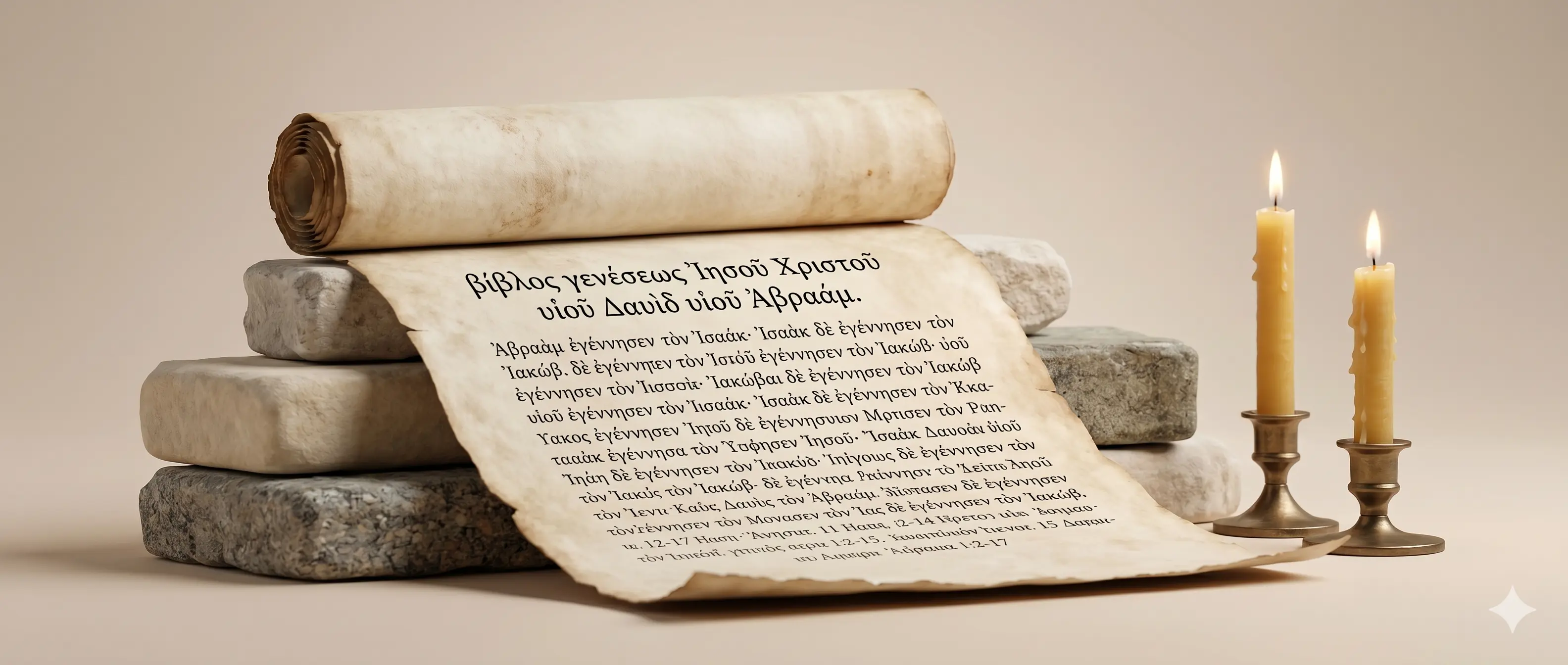
The Messianic Line
Matthew 1:1–17
Overview
The Gospel of Matthew opens with the best news ever sent from heaven, chronicling Christ’s arrival into the world to save sinners. As the angel declared, we receive “good tidings of great joy, which shall be to all people” (Luke 2:10 KJV). This study of Matthew 1:1–17, “The book of generation,” traces the lineage of the very One who made the world (Gen 5:1). The Evangelist constructs this record to establish Jesus Christ’s undisputed legal claim to the Davidic throne via His foster father, Joseph. We will examine how Matthew validates Christ’s identity as the son of David and the son of Abraham. Moreover, we see a remarkable testament to divine grace in this enumeration: the inclusion of four women — Tamar, Rahab, Ruth, and Bathsheba — a profound demonstration of God’s choice of the most unlikely vessels for His sovereign purposes.
Observations
The Royal Pedigree (v. 1)
The book of generation — a phrase mirroring the language found in Genesis 5:1. While the Old Testament commences with the genealogy of the created world, the New Testament possesses a surpassing glory, for it opens with the lineage of the very One who made the world.
“Of Jesus Christ” — The name “Jesus,” conferred upon our Savior at His circumcision (Luke 2:21), designated His common name during His earthly sojourn. The title “Christ” only came into general use near the conclusion of His ministry (Matt 26:68; 27:17). The composite form, “Jesus Christ,” was not commonly adopted until after His ascension and the establishment of the Church, despite its being uttered by the Lord in His High Priestly intercession (John 17:3). Therefore, its placement in the Gospel’s introduction signifies the period of the Evangelist’s composition, not the historical timeframe of the events recounted.
The Evangelist commences his narrative of Jesus Christ by tracing His descent from the forefather Abraham. Since he was the original recipient of the promise that the Messiah would arise from his seed (Gen 12:3; 22:18), this record is essential. Furthermore, Matthew portrays the Lord as the anointed King descending from the sovereign house of David (2 Sam 7:12–16). For the Hebrew mind, these two pillars were the necessary foundations for any authentic lineage of Christ; consequently, this introductory verse marks the first Gospel as distinctly Jewish.
At first glance, one might wonder whether this lineage is merely a repetitive or superfluous record, or perhaps a display of worldly pride typical of secular pedigrees. But let’s ask: what is the divine purpose underlying this sacred enumeration?
The primary objective of this lineage is to demonstrate that Jesus is the prophesied Messiah — the son of David and the son of Abraham — by connecting Him to the specific nation and family. Because the Jewish people upheld precise genealogical records and emphasized ancestry, proving Jesus’ descent from David was essential for Jewish Christians to accept His Messiahship.
The Succession of Grace (vv. 2–16)
The Evangelist proceeds to enumerate the genealogy of our Lord through Joseph. This sacred record serves to validate His legal right to the Davidic throne via His foster father, establishing a royal succession rather than a biological descent through Mary. While the Gospel of Luke chronicles the Savior’s natural bloodline, Matthew focuses here on the judicial lineage that confirms His sovereign standing.
To be honest, reconciling the particulars of this lineage with the record of Luke or the ancient chronicles of the Old Testament presents certain complexities. Yet, such genealogical obscurities must not obscure our vision of the sacred whole.
The Hebrew fascination with ancestry occasionally proved a perilous diversion from the faith. For this reason, the Apostle Paul admonished Timothy to beware of those preoccupied with endless genealogies (1 Tim 1:4), a sentiment he echoed with equal gravity in his counsel to Titus (Titus 3:9).
While many observations may be drawn from this enumeration, one profound truth merits our special consideration:
“With few exceptions, these names belong to individuals of little worldly renown; the later figures remain entirely obscure. Thus, our Lord appeared as ‘a root out of dry ground,’ emerging from the withered stem of Jesse to demonstrate that He placed no value upon earthly majesty.” — Spurgeon
This lineage is distinguished by the remarkable inclusion of four women. In the ancient world, women were seldom recorded in genealogical accounts; however, these four individuals stand as profound monuments of divine grace. Their presence illustrates how the Lord may choose the most unlikely vessels to accomplish His sovereign purposes.
- Tamar: She assumed the guise of a harlot with her father-in-law, Judah, to ensure the birth of Perez and Zerah. (Gen 38)
- Rahab: A Gentile woman and a prostitute, yet God extended extraordinary mercy to deliver her from impending wrath and her former way of life. (Jos 2; 6:22–23)
- Ruth: A Moabitess and a stranger to the commonwealth of Israel until her conversion brought her into the lineage of the Messiah. (Ruth 1)
- The wife of Uriah: Bathsheba, noted for her grievous fall with David (2 Sam 11), is mentioned indirectly in verse six. Matthew’s specific phrasing, “Uriah’s wife,” may emphasize that her husband was a Hittite rather than an Israelite.
“Men and women, notorious for their evil character, lie in the direct line of his descent. This was permitted, that He might fully represent our fallen race.” — Meyer
The Divine Chronology (v. 17)
The Evangelist concludes this genealogical record in verse 17, organizing the lineage into three distinct sets of fourteen generations, each punctuated by significant historical epochs. It is evident that various names were purposely omitted when this account is measured against the chronicles found in 1 Chronicles 6:3–15. The initial fourteen generations witness the house of David ascending like the morning sun; the subsequent fourteen behold it reaching its majestic zenith; while the final fourteen depict its steady decline, eventually receding into the modest household of a carpenter. Yet, from this humble obscurity, Christ finally shines forth as the glory of His people Israel.
Cross-references
- Genesis 5:1 — “the book of the genealogy of Adam” — the OT parallel Matthew deliberately echoes
- Genesis 12:3 — the Abrahamic promise: “in you all the families of the earth shall be blessed”
- Genesis 22:18 — “in your seed all the nations of the earth shall be blessed” — the Messianic seed promise confirmed
- 2 Samuel 7:12–16 — the Davidic covenant: “your throne shall be established forever”
- Luke 3 — Luke’s parallel genealogy tracing the natural bloodline through Mary
- 1 Timothy 1:4 — Paul’s warning against “endless genealogies which cause disputes”
- Titus 3:9 — “avoid foolish disputes, genealogies… they are unprofitable and useless”
- Genesis 38 — Tamar and Judah
- Joshua 2 — Rahab and the spies
- Ruth 1 — Ruth’s loyalty to Naomi; a foreigner grafted into the covenant line
- 2 Samuel 11 — David and Bathsheba
- 1 Chronicles 6:3–15 — the genealogical record for comparison
Questions for reflection
- In light of the Lord’s purposeful inclusion of unlikely and flawed figures such as Tamar, Rahab, Ruth, and Bathsheba within the lineage of Christ, how does this profound demonstration of unmerited favor offer redemption for the imperfections and brokenness found in my own life?
- The royal pedigree traversed three distinct historical epochs before finally revealing the Messiah. In which area of my personal journey must I cultivate a deeper reliance upon the Lord’s sovereign and patient providence?
- As the Evangelist has established Jesus’ undisputed legal claim to the throne of David, does my daily walk truly bear witness to the reality that He is my rightful and sovereign Lord?
Comment received
Thank you — it will appear here once reviewed.