If you can believe
Mark 9:14–29
Overview
Mark 9:14–29 follows immediately after the Transfiguration. While Peter, James, and John were witnessing glory on the mountain, the remaining disciples were surrounded at its foot by a failing confrontation — a demon they could not cast out, a desperate father, and scribes quick to exploit the moment.
The passage addresses a universal human experience: bringing a real and overwhelming need to God and finding the immediate situation worsen, not improve. The demon seizes the boy more violently the moment Jesus appears. The crowd declares him dead. These are the conditions in which faith is most tested — and most revealed.
At its centre is one of the most honest confessions in all of Scripture: “Lord, I believe; help my unbelief.” Faith is not the absence of doubt. It is the act of reaching for God while doubt is still present.
Observations
Who are the characters in the story? (v. 14)
“And when He came to the disciples, He saw a great multitude around them, and scribes disputing with them.” — Mark 9:14 NKJV
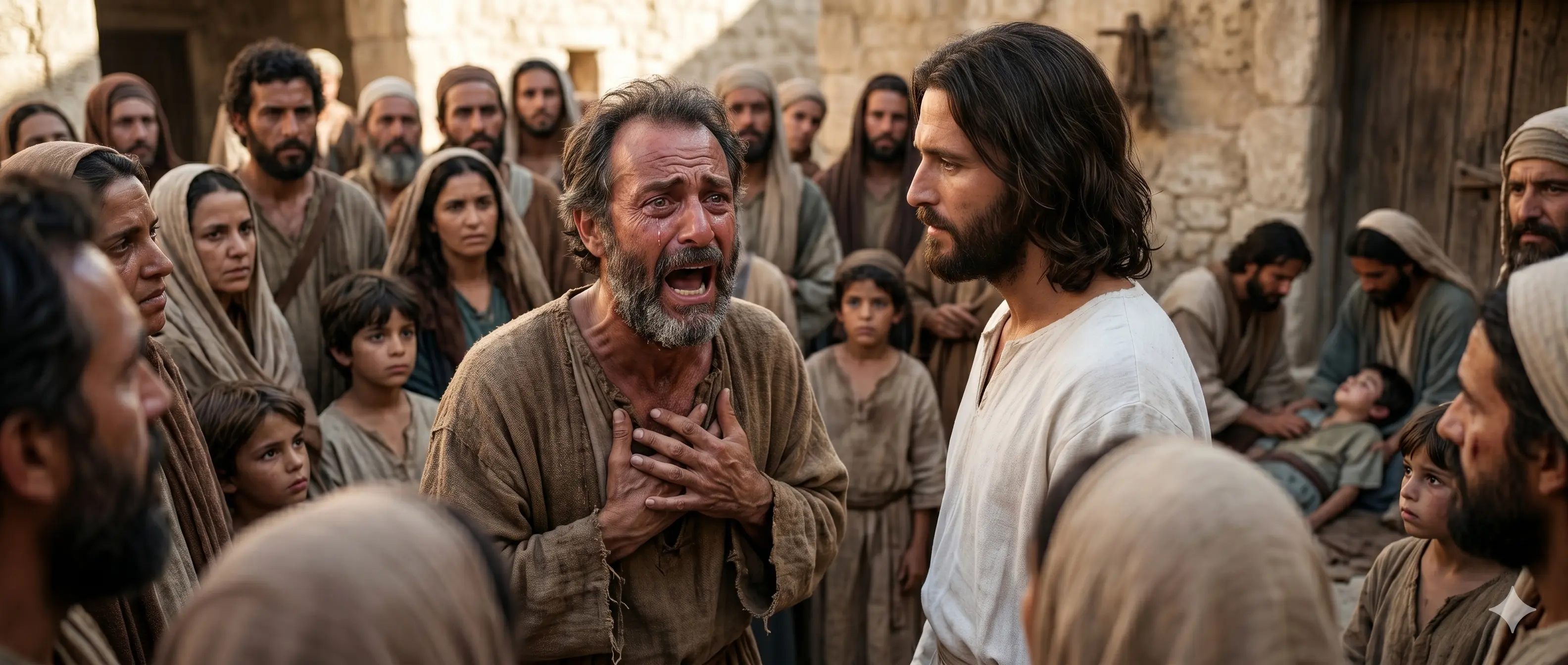
When Jesus asked what they were arguing about, a man from the crowd shouted:
“Teacher, I brought my son to you, for he has a spirit that makes him mute. And wherever it seizes him, it throws him down, and he foams and grinds his teeth and becomes rigid. So I asked your disciples to cast it out, and they were not able.” — Mark 9:17–18 ESV
The argument in the crowd must have been about the disciples’ inability to heal the boy. Scribes within the gathering seized this chance to shame the disciples, crowding them with interrogations intended to cast both the followers and their Master as frauds. These rabbis boldly proclaimed that the demon present was a force neither Christ nor His disciples could defeat. As the crowd began to favor the scribes’ arguments, a wave of disdain and mockery washed over the spectators.
For a moment, Jesus permitted the evil spirit to display his power, that the beholders might comprehend the deliverance about to be wrought. — Desire of Ages, p. 427
The disciples’ inability to provide a solution might have caused the father to lose heart. He was fortunate, however, to recognize that their failure did not imply Jesus was equally powerless. There are times when those we depend on for guidance or assistance simply will not possess the solutions we require.
Lesson: When attempts to fix a problem fail, or reaching out doesn’t seem helpful, trust God’s wisdom and love for you and keep reaching out.
The father ran to Jesus (vv. 19–20)
The Savior’s response is truly remarkable: “O faithless generation.” Despite His continued presence and the countless wonders He performed, skepticism regarding His divinity persisted. This struggle with doubt appears to be a perennial human condition. Consider the ancient Israelites in Numbers 14:11; even after witnessing miraculous deliverances in Egypt and the desert, they faltered in their conviction. Might we be mirroring that same lack of faith in our own lives today?
“And the LORD said to Moses, ‘How long will this people despise me? And how long will they not believe in me, in spite of all the signs that I have done among them?’” — Numbers 14:11 ESV
Why did the situation appear to worsen when it was brought to Jesus? (vv. 20, 26)
“Then they brought him to Him. And when he saw Him, immediately the spirit convulsed him, and he fell on the ground and wallowed, foaming at the mouth.” … “Then the spirit cried out, convulsed him greatly, and came out of him. And he became as one dead, so that many said, ‘He is dead.’” — Mark 9:20, 26 NKJV
The hidden characters (vv. 20–26)
For we are in a battle. Here, the prince of life and the prince of the powers of darkness had met on the battlefield. Satan was seeking to hold his victim under his control. Angels of light and the hosts of evil angels, unseen, were pressing near to behold the conflict. For a moment, Jesus permitted the evil spirit to display his power, that the beholders might comprehend the deliverance about to be wrought.
Christ was here to fulfill His mission to “preach deliverance to the captives… to set at liberty them that are bruised.”
How should this knowledge change the way we deal with difficult times?
“For though we walk in the flesh, we do not war according to the flesh. For the weapons of our warfare are not carnal but mighty in God for pulling down strongholds, casting down arguments and every high thing that exalts itself against the knowledge of God, bringing every thought into captivity to the obedience of Christ.” — 2 Corinthians 10:3–5 NKJV
“For we do not wrestle against flesh and blood, but against principalities, against powers, against the rulers of the darkness of this age, against spiritual hosts of wickedness in the heavenly places. Therefore take up the whole armor of God, that you may be able to withstand in the evil day, and having done all, to stand.” — Ephesians 6:12–13 NKJV
Lesson: Our struggles are a part of the “Great Controversy” between good and evil.
”If you can believe” (vv. 21–24)
Reflect upon the duration of their struggle: How long had this father and his child endured such a trial? The answer is given in Mark 9:21: “From childhood.” The sheer longevity and apparent futility of their plight serve to remind us that no burden is too immense for His intervention.
Lesson: Whether your tribulations are minor or overwhelming, the Savior is capable of resolving them; do not hesitate to bring them before Him!
“Jesus said to him, ‘If you can believe, all things are possible to him who believes.’ Immediately the father of the child cried out and said with tears, ‘Lord, I believe; help my unbelief!’” — Mark 9:23–24 NKJV
We arrive at the narrative’s pivotal moment: “If you can believe, all things are possible.” This profound assurance is echoed throughout the Gospels in Mark 11:23, Matthew 17:20, and Matthew 21:21–22. Indeed, without such unwavering conviction, it remains impossible to find favor in the sight of the Almighty (Hebrews 11:6).
Finally
The scriptural promises remind us that we do not have to face these trials in our own strength. Even when the world feels unstable, we can find steady ground.
“God is our refuge and strength, a very present help in trouble. Therefore will not we fear, though the earth be removed, and though the mountains be carried into the midst of the sea.” — Psalm 46:1–2 KJV
Furthermore, the Savior extends a personal invitation to those who are exhausted by life’s burdens. He offers a rest that the world cannot provide.
“Come to Me, all you who labor and are heavy laden, and I will give you rest.” — Matthew 11:28 NKJV
The ultimate source of stability comes from a deliberate choice to keep God at the center of our focus. When we acknowledge His presence at our right hand, our perspective on the difficulty shifts.
“I have set the LORD always before me; because He is at my right hand I shall not be moved.” — Psalm 16:8 NKJV
That’s the knowledge you need.
Cross-references
- Numbers 14:11 — Israel’s persistent unbelief despite all the signs God had performed
- Luke 4:18 — Jesus’ mission: to preach deliverance to the captives
- 2 Corinthians 10:3–5 — our weapons are not carnal but mighty in God
- Ephesians 6:12–18 — the whole armour of God against spiritual powers
- Mark 11:23 — faith and the mountain
- Matthew 17:20 — faith as a mustard seed; nothing impossible
- Matthew 21:21–22 — ask in prayer, believing, and you will receive
- Hebrews 11:6 — without faith it is impossible to please God
- Psalm 46:1–2 — God is our refuge and strength, a very present help in trouble
- Matthew 11:28 — the invitation to the exhausted
- Psalm 16:8 — “I have set the LORD always before me… I shall not be moved”
Questions for reflection
- When attempts to fix a problem or reach out for help fail, this is an invitation to trust God’s wisdom and love and keep reaching out to Him.
- Our personal struggles are part of a larger spiritual conflict — the “Great Controversy” — and we must use spiritual weapons (prayer, faith, the Word of God) rather than relying on human strength alone.
- The promise that “all things are possible to him who believes” requires us to be honest about our doubt, echoing the father’s plea: “Lord, I believe; help my unbelief!”
Comment received
Thank you — it will appear here once reviewed.