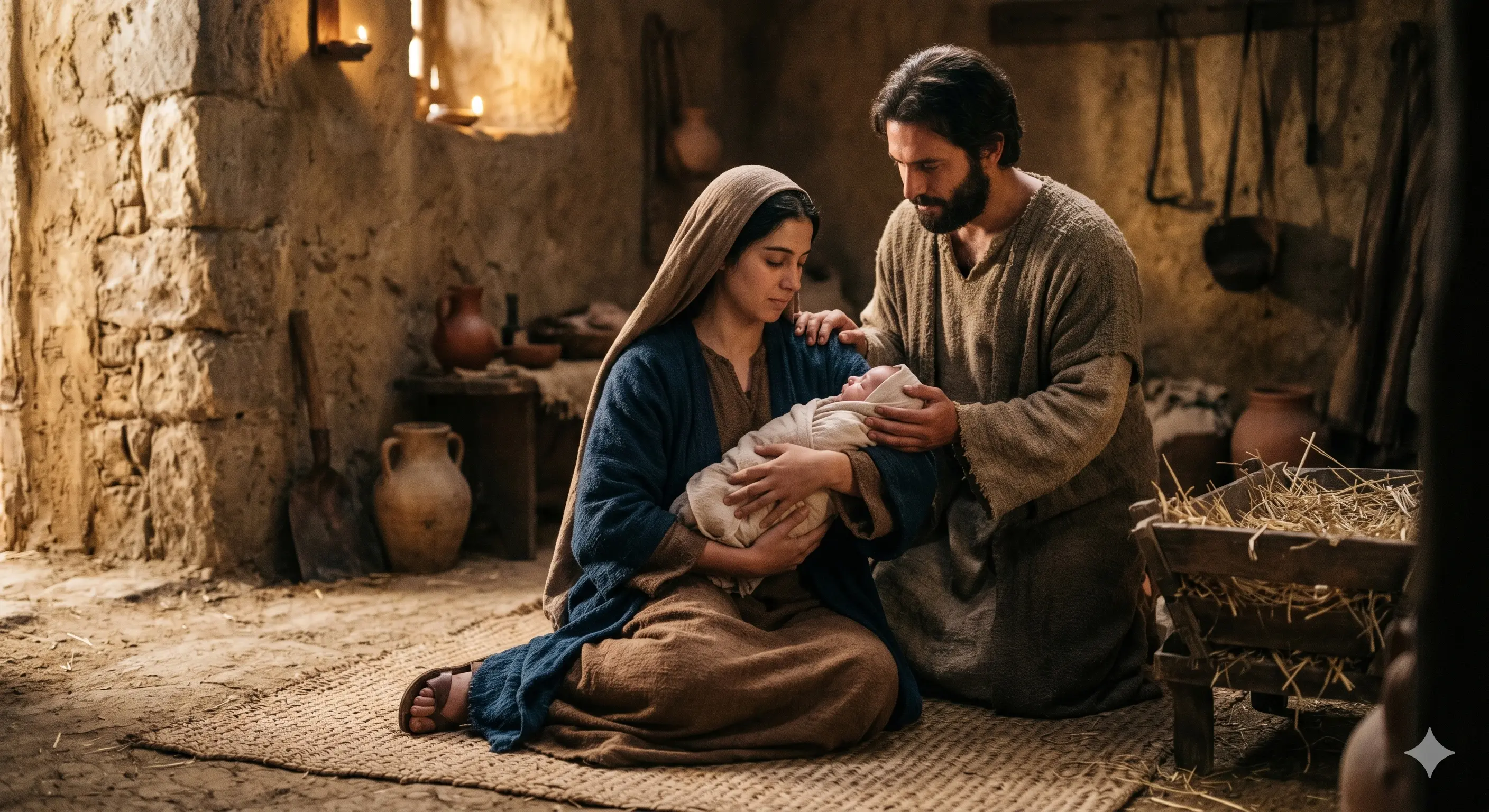
Christ Born of Mary
Matthew 1:18–25
Overview
Matthew 1:18–25 shifts from the genealogy of the Messianic line to the moment the promise becomes flesh. Matthew keeps the account spare — omitting the richer detail found in Luke’s Gospel — yet what he includes is deliberate: Jewish betrothal law, Joseph’s just character, the divine name decreed for the child, and the fulfilment of Isaiah’s ancient sign.
This passage is as much a study in obedience under pressure as it is a birth narrative. Mary carried both the glory of being chosen and the weight of public misunderstanding. Joseph navigated justice and mercy before receiving divine clarity. In both, we see what it looks like to hold integrity under circumstances no one else could fully see or understand.
The controversy this event raised was real and long-lasting — passages in John 8:41 show that questions about Jesus’ background followed Him into His public ministry.
Observations
Jewish Betrothal and Joseph’s Dilemma (vv. 18–19)
The text records that “Mary was betrothed to Joseph,” though some translations prefer the word “espoused.” To understand this, let us consider that Jewish matrimonial customs typically involved three distinct phases.
- Engagement: This could happen when the bride and groom-to-be were quite young, and was often arranged by the parents.
- Betrothal: This made the previous engagement official and binding. During betrothal, the couple was considered husband and wife, and a betrothal could only be broken by divorce. Betrothal typically lasted a year.
- Marriage: This took place after the wedding, after the year of betrothal.
Matthew simply records the miraculous conception and birth of Jesus, omitting the more detailed information found in Luke’s account. However, we must recognize that this sacred event was difficult for people to accept at the time and remains controversial for many today. Passages in John 8:19 and John 8:41 show that this skepticism and doubt about His background were real historical issues.
“There was no other way of his being born; for had he been of a sinful father, how should he have possessed a sinless nature? He is born of a woman, that he might be human; but not by man, that he might not be sinful.” — Spurgeon
Furthermore, we find a profound implication in these verses: the Holy Spirit is a sentient, divine Person. As illuminated in other scriptural records, such as Acts 5:3–4, He possesses a unique identity, standing in eternal equality with both the Father and the Son, a triune distinction further confirmed in Matthew 28:19 and 2 Corinthians 13:14.
For a moment, let’s consider what a great trial this was for a godly young woman like Mary, and for Joseph, her betrothed. Her situation was distressing and humiliating. But it’s her consciousness of her own integrity, and the strongest confidence in God, that could have supported her in such trying circumstances, where her reputation, her honor, and her life were at stake. The intensity of this situation is revealed in the next verse (v. 19).
Joseph seeks a quiet divorce. Whether for reasons of suspected unfaithfulness or the justice of his character, Joseph thought it altogether unsuitable to continue with the marriage. But he still had to follow the Jewish culture of breaking the engagement by divorce (Deut 24:1). Yet his nature as a just man also did not want to make this an unnecessary hardship or stigma upon Mary. Quite a lesson to young men today — when we have to do a severe thing, let us choose the tenderest manner. We may not need to do it at all.
The Name of Jesus (vv. 20–21)
An angel appeared to Joseph in a dream as he contemplated his situation, persuading him to proceed with taking Mary as his wife. Though troubled by her mysterious pregnancy, he received divine assurance regarding the nature of the conception — a miraculous event described in Luke 1:35 as an overshadowing.
The name decreed for the child is JESUS, derived from the Hebrew “Yashua,” which means “Jehovah the Savior.” While the name was common during that era, it holds profound significance today, as the Apostle Peter declared that no other name under heaven offers salvation (Acts 4:12 KJV).
This name directly defines Christ’s purpose: “He will save His people from their sins.” Reflecting the mission stated in Luke 19:10 to seek and save the lost, Jesus addresses humanity in its fallen state, offering a threefold deliverance: first, from the penalty of sin; then, from its power; and ultimately, from its very presence.
A profound nuance found in the phrasing “His people” suggests that salvation is not restricted to the Jewish nation alone, as the term “God’s people” might have implied in that context. Instead, it is through belonging to Jesus that one finds true redemption from sin.
Fulfillment of Prophecy — Immanuel (vv. 22–23)
This virgin birth of Jesus is a fulfillment of prophecy (Isaiah 7:14):
“Behold, the virgin shall be with child, and bear a Son, and they shall call His name Immanuel,” which is translated, “God with us.” — Matthew 1:23
What is the meaning of this name — Immanuel? In what sense is Christ God with us?
“Jesus is called Immanuel, or God with us, in his incarnation; God with us, by the influences of his Holy Spirit, in the holy sacrament, in the preaching of his word, in private prayer. And God with us, through every action of our life, that we begin, continue, and end in his name. He is God with us, to comfort, enlighten, protect, and defend us, in every time of temptation and trial, in the hour of death, in the day of judgment; and God with us and in us, and we with and in him, to all eternity.” — Clarke
“The best of all is, God is with us,” were purportedly the concluding remarks of John Wesley, the founder of Methodism. As you contemplate what your own final testament might be, consider that Wesley anchored his departing soul to the profound reality of the divine presence.
Joseph’s Obedience (vv. 24–25)
The submissive spirit of Joseph is highly significant, for he acted precisely according to the divine instructions he received. Following the Savior’s arrival, Joseph and Mary experienced a standard matrimonial relationship. Consequently, one finds no scriptural support within this passage for the theological concept regarding the “perpetual virginity” of Mary.
Word study
| Hebrew | Transliteration | Meaning | Verse |
|---|---|---|---|
| יֵשׁוּעַ | Yeshua (Yashua) | Jehovah the Savior / YHWH saves | Matthew 1:21 |
| עִמָּנוּ אֵל | Immanuel | God with us | Matthew 1:23 / Isaiah 7:14 |
Cross-references
- Isaiah 7:14 — The original Immanuel prophecy fulfilled in the virgin birth
- Luke 1:35 — The angel’s explanation of the miraculous conception to Mary
- Acts 4:12 — “No other name under heaven” — Peter’s declaration of the exclusivity of Jesus’ saving name
- Acts 5:3–4 — The Holy Spirit as a divine person; lying to the Spirit equated with lying to God
- Matthew 28:19 — The triune formula of the Great Commission confirming the distinct persons of the Godhead
- 2 Corinthians 13:14 — The Apostolic benediction naming Father, Son, and Holy Spirit
- Luke 19:10 — “The Son of Man came to seek and to save the lost” — defining Christ’s mission
- John 8:41 — The Pharisees’ veiled accusation revealing lingering doubt about Jesus’ birth
- Deuteronomy 24:1 — The law governing divorce, the mechanism Joseph planned to use quietly
Questions for reflection
-
Though Mary faced intense shame and perilous circumstances during this trial, she remained steadfast in her personal righteousness and divine assurance. In what spheres of your own existence are you invited to uphold your honor and reliance upon the Lord’s providence, especially when circumstances appear agonizing or are misjudged by those around you?
-
Joseph, when confronted with a painful choice, endeavored to proceed in the “tenderest manner.” In what way does this example influence your own methodology when navigating disputes, offering discipline, or engaging in arduous dialogues with others?
-
Scripture interprets “Immanuel” as “God with us” — extending beyond the nativity to our supplications, our routine labors, and our tribulations. How might your outlook on immediate hardships be transformed if you were to more consciously fasten your thoughts to the reality of God’s presence in every action you begin, continue, and end?
Comment received
Thank you — it will appear here once reviewed.