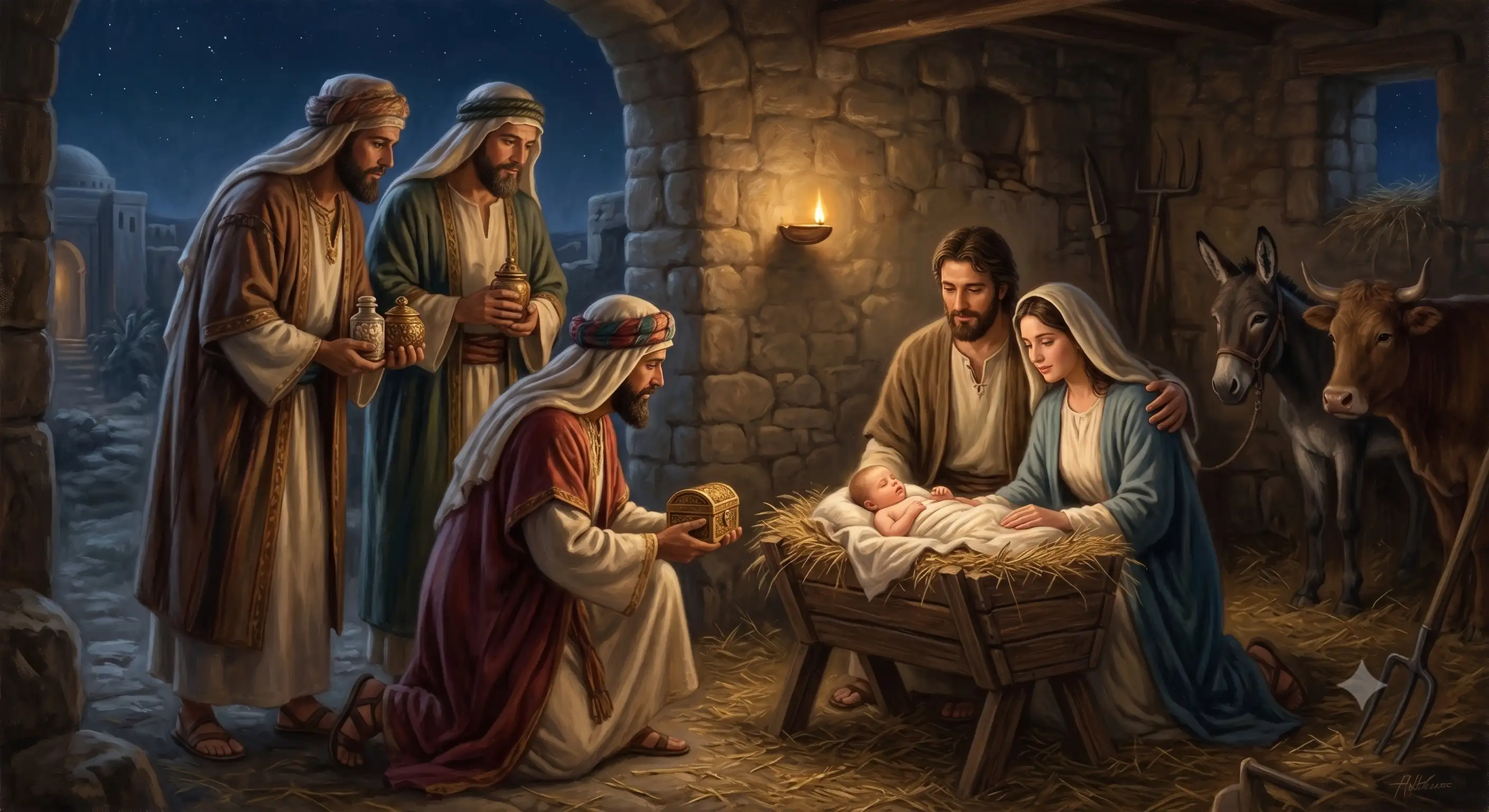
Christ Born in Bethlehem of Judah
Matthew 2:1–8
Overview
Matthew 2 moves from the birth narrative to the first test the newborn King faced: opposition from the powers of this world. The chapter falls naturally into five movements — the Magi’s inquiry, their homage, the flight to Egypt, the massacre of the innocents, and the return to Nazareth. This study focuses on the opening scene: the arrival of the Wise Men and the fearful reaction it provoked in Herod and Jerusalem.
A study of the second chapter of Matthew, the nativity of Jesus in Bethlehem during King Herod’s era. The primary theme underscores that, despite being the “desire of all nations,” Christ’s arrival was marked by humility and largely went unnoticed by His own people, fulfilling the sentiment that “He came to His own, and His own did not receive Him” (John 1:11).
The irony woven through this passage is sharp: Gentile philosophers travel hundreds of miles guided by a star, while the chief priests of Israel — who could quote the relevant prophecy from memory — could not be moved seven miles down the road to Bethlehem.
Observations
Who Were the Wise Men? (vv. 1–2)
Though He was the Desire of all nations, His coming into the world was humble, little observed, and taken notice of. His bed was obscure and unregarded. “He came to His own, and His own did not receive Him” (John 1:11).
Who were these wise men? They were called Magoi — magicians. The Magi, among the Persians, were their philosophers and their priests. So who are they?
- They were Gentiles who did not belong to the commonwealth of Israel. The Jews regarded not Christ, but these Gentiles did. Note, many times those who are nearest to the means are furthest from the end (Matt 8:11–12).
- They were scholars — they dealt in arts, curious arts. Known to be wise (1 Kings 4:28–34). Good scholars should be good Christians, and then they complete their learning when they learn Christ.
- They were men of the East. Arabia is called the land of the East (Genesis 25:6) and the Arabs are also called men of the east (Judges 6:3).
Beyond these details, our knowledge of these individuals is quite limited.
Two Ways God Announced His Coming (v. 2)
God announced the arrival of Christ in ways most familiar to each group: an angel appeared to Jewish shepherds (Luke 2), while a star guided Gentile philosophers. It is noteworthy to compare how they recognized Him: the Gentiles identified the timing through celestial signs — a star, whereas the Jews identified the location through the scriptures (Micah 5:2). Paradoxically, although the chief priests in Jerusalem could pinpoint Christ’s birthplace, they remained completely unconcerned and made no effort to honor or visit Him.
”King of the Jews” — A Royal Title (v. 2)
The wise men posed a specific inquiry: “Where is he that is born of the Jews?” Their question was not whether such a birth had occurred — of that they were certain — but rather where the event had taken place.
By identifying Christ as “the King of the Jews” (v. 2), they acknowledged Him as the expected Messiah. This title aligns with the prophecy in Jeremiah 23:5–8, which foretells that in His days Judah will be saved and refers to Him as “The Lord Our Righteousness.”
Unlike traditional monarchs, He was born a king. However, as the wise men sought information from door to door, they found that no one could assist them. This highlights a profound level of ignorance regarding spiritual matters, both in the world at large and within the church itself.
Herod’s Troubled Reception (vv. 3–8)
When word finally reached Herod, he was deeply troubled (v. 3). Despite his long reign, he appeared to be a stranger to the Old Testament prophecies, perhaps hoping his own kingdom would endure indefinitely. While one might expect all of Jerusalem to rejoice at the news of their King’s arrival, the city instead shared in Herod’s distress, with only a few exceptions who truly waited for the consolation of Israel.
This troubled reaction stems from a mistaken belief that the Messiah’s kingdom would conflict with worldly powers, and more deeply, from a foolish preference for the slavery of sin over the glorious liberty of God’s children — a liberty many reject simply because they do not know it.
Driven by jealousy and a desire to destroy the infant king, Herod feigned piety to discover His location. However, he was ultimately outmaneuvered. Even though the birth occurred only seven miles from Jerusalem, it is remarkable how God can conceal His purposes and methods from those who seek to oppose Him.
Cross-references
- John 1:11 — “He came to His own, and His own did not receive Him” — the thread of rejection woven through the entire chapter
- Micah 5:2 — The prophecy naming Bethlehem as the birthplace of the Ruler of Israel
- Jeremiah 23:5–8 — The Messianic Branch prophecy; Christ as “The Lord Our Righteousness”
- Matthew 8:11–12 — Those nearest the means are often furthest from the end — Gentiles welcomed, sons of the kingdom cast out
- Luke 2 — The angelic announcement to Jewish shepherds — God’s parallel witness to His own people
- 1 Kings 4:28–34 — The tradition of wisdom associated with the East, exemplified in Solomon
- Genesis 25:6 — Arabia identified as “the country of the east” from the time of Abraham
- Judges 6:3 — The Arabs referred to as “people of the East” in the period of the Judges
Questions for reflection
-
The chief priests knew Micah 5:2 well enough to quote it on the spot, yet they made no effort to journey to Bethlehem. In what areas of your spiritual life do you possess biblical knowledge that has yet to move you to action?
-
God announced Christ’s arrival through a star for Gentile astronomers and through scripture for Jewish shepherds — each in a language they could already read. How has God drawn you toward Himself through what was already familiar in your world?
-
Herod was troubled not because Christ threatened his life, but because Christ threatened his kingdom. What personal kingdoms — ambitions, comforts, or plans — might you be guarding against the full reign of Christ?
Comment received
Thank you — it will appear here once reviewed.