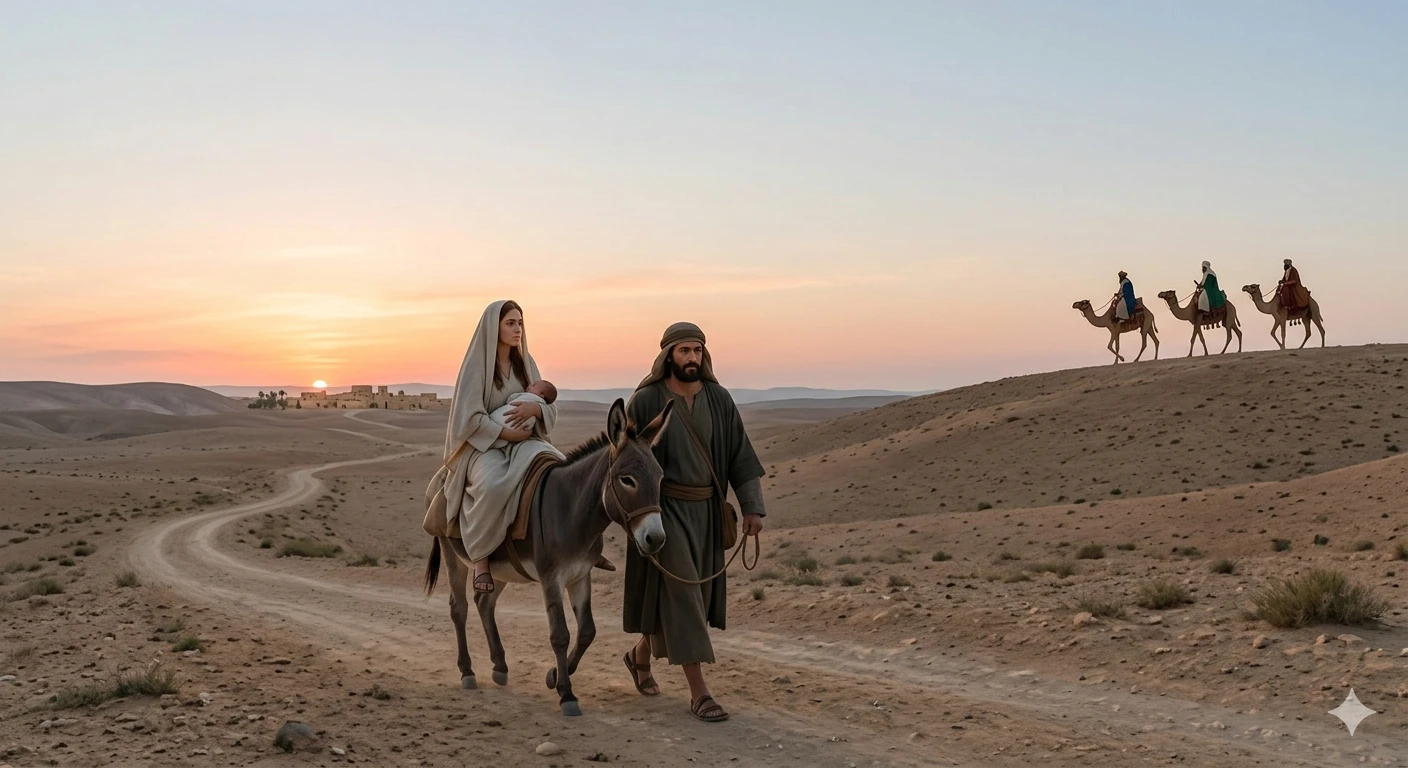
Led by a Star, Hidden in Egypt
Matthew 2:9–23
Overview
We continue our study of Matthew 2. In the previous section, Herod was troubled by the news of Jesus’ birth. Now the wise men are led by the star and finally find Christ.
This half of the chapter covers four distinct movements: the Magi’s worship and quiet departure, the holy family’s flight into Egypt, Herod’s brutal massacre of the infants of Bethlehem, and the return from Egypt to settle in the obscure town of Nazareth. Each scene is held together by a common thread — Matthew’s repeated note that “this was to fulfil what was spoken by the prophets.” The Messiah’s path, even from infancy, runs along lines drawn long before His birth.
What emerges is a picture of a King whose kingdom operates entirely differently from the kingdoms of this world. He is worshipped by outsiders and hunted by those in power. He is sheltered in the land that once enslaved His people. He grows up in a town so overlooked that it became a byword for insignificance. Every detail is a sign — and Matthew means for us to see them all.
Observations
God Graciously Directed Them (vv. 9–10)
-
The star first made them aware of Christ’s birth, then disappeared for a time. When it was no longer visible, they used ordinary means: they asked questions and searched diligently.
-
This reminds us that when we go as far as we can on the path of duty, God can guide us beyond what we could do on our own.
-
If by faith we acknowledge God in our ways, we may trust that we are under His guidance. He “guides with His eye” (Psalm 32:8), and He gives light to those who seek Christ (2 Peter 1:19).
When they saw the star again, “they rejoiced with exceeding great joy” (v. 10). Those who seek the Lord have reason to rejoice (Psalm 105:3).
They Worshipped Him (vv. 11–12)
When the wise men entered the house and saw the child with Mary, His mother, they “fell down and worshipped Him” (v. 11). Their wisdom is seen in this: they looked beyond the humble circumstances and recognized the glory of the Son of God in the child before them.
-
They gave Jesus the honor they did not give to Herod. Though Jesus appeared as a poor and humble child, they worshipped Him as Lord (Psalm 45:11).
-
They first offered themselves in worship, and then offered their gifts. True worship begins with the surrender of the heart.
-
Their gifts were gold, frankincense, and myrrh. In the East, gifts were commonly presented when honoring kings. In this way, they acknowledged Jesus’ greatness (Ps 72:10; Isa 60:6).
-
What God has given us should be used to honor Him. If we sincerely give ourselves to Christ, we should also be willing to give Him what is valuable to us.
-
Some have seen meaning in the gifts: gold for a King, frankincense for God, and myrrh for the Man who would die, since myrrh was used in burial.
After worshipping Christ, the wise men were warned by God in a dream not to return to Herod. They obeyed and went back to their country by another route. In this way, God prevented the harm Herod intended against the child Jesus. We do not hear of the wise men again.
The Flight into Egypt (vv. 13–15)
Joseph is commanded to take the child and His mother to Egypt. From the beginning, Jesus’ life was marked by trouble. Even as a child, He experienced danger and exile. In this, He also gives His people an example: “When they persecute you in one city, flee to another”.
Why Egypt?
Egypt had a painful history for Israel. It was known for idolatry, oppression, and cruelty toward God’s people. It had once been the house of bondage, and Israel’s children had suffered there. Yet God appointed Egypt as a place of refuge for the holy child Jesus.
This teaches us that God can use even unlikely places for His purposes. The earth is the Lord’s, and He can make the worst places serve His good plans.
Joseph’s obedience
Joseph’s obedience is remarkable. The journey was inconvenient and dangerous for the young child and His mother. They had few resources and could not expect an easy welcome in Egypt. Yet Joseph obeyed promptly, as Abraham once obeyed God’s call.
Fulfilled Scripture
Matthew notes that this fulfilled the Scripture: “Out of Egypt I called My Son”. Matthew often highlights fulfilled prophecy, likely because he wrote especially with Jewish readers in mind. For them, the fulfillment of Scripture would strongly confirm that Jesus is the promised Messiah.
Herod Kills the Children (vv. 16–18)
When Herod realized that the wise men had not returned, he became furious. He had waited for their report, but they had gone home another way. His anger turned into brutal action.
- He ordered the killing of all male children two years old and under.
- The order covered Bethlehem and the surrounding region, not only the town itself.
Children are naturally protected by human affection and by just laws. Yet Herod sacrificed them to his own fear and rage. This shows how early opposition to Christ and His kingdom began.
The suffering of children in a fallen world reminds us of the reality of sin. But this particular event should also be seen as martyrdom: these children suffered because of the world’s hostility toward Christ.
Fulfilled Scripture
Matthew says this fulfilled Jeremiah’s prophecy: “A voice was heard in Ramah” (Jeremiah 40:1). In Jeremiah’s time, Ramah was associated with sorrow and captivity after Jerusalem’s destruction. Now the prophecy is fulfilled again in the grief of Bethlehem’s mothers, mourning the death of their children.
The Return to Israel and Settlement in Nazareth (vv. 19–23)
After Herod died, the angel of the Lord appeared to Joseph in Egypt and told him to return to the land of Israel. Egypt was a temporary shelter, not a permanent home. Christ was sent to the lost sheep of Israel, and therefore, He had to return.
They settled in Galilee
Joseph did not settle in Judea because Herod’s son Archelaus was ruling there. Being warned by God, he went to Galilee and settled in Nazareth. This was a suitable place, since Mary had lived there before Jesus’ birth, and Joseph was likely known there as well (Luke 1:26–27).
From this place, Jesus became known as Jesus of Nazareth. To many Jews, this became a stumbling block: “Can anything good come out of Nazareth?” Yet God chose this humble and despised place for His Son.
He would be called a Nazarene
-
This may point to Christ as the true and greater “Nazarite” — not because He strictly followed the Nazarite vow, since He drank wine and touched the dead, but because He was uniquely holy and set apart for God’s saving work. In this sense, figures such as Samson pointed forward to Him (Judges 13:5).
-
It also points to the shame and rejection Christ would bear. To be called a Nazarene was to be treated as lowly and despised. No single prophet says this exact phrase, but the prophets often foretold that the Messiah would be despised and rejected (Isaiah 53:2–3; Psalm 22:6–7; Psalm 69:7–8).
This should encourage us. No name of reproach suffered for the sake of Christ should seem too hard to bear, since our Master Himself was called a Nazarene.
Cross-references
- Psalm 32:8 — “I will guide you with My eye” — God’s direction for those who walk in faith
- 2 Peter 1:19 — The prophetic word as a lamp; Christ as the Morning Star who gives light to seekers
- Psalm 105:3 — “Let the hearts of those rejoice who seek the Lord” — the Magi’s joy at finding the star again
- Psalm 72:10 — Kings bringing gifts; the Messianic King receiving tribute from all nations
- Isaiah 60:6 — Gold and incense brought by the nations; the Magi’s gifts fulfilling prophetic imagery
- Hosea 11:1 — “Out of Egypt I called My Son” — the flight to Egypt as a recapitulation of Israel’s history
- Matthew 10:23 — Christ’s own instruction to flee persecution — a pattern He Himself lived out
- Jeremiah 31:15 — Rachel weeping for her children; the grief of Bethlehem fulfilling ancient sorrow
- Isaiah 53:2–3 — The Messiah despised and rejected; Nazareth as part of His humiliation
- Psalm 22:6–7 — The reproach and scorn borne by the Messiah
- Psalm 69:7–8 — Bearing reproach for God’s sake — the cost Christ carried and calls us to share
Questions for reflection
-
The wise men used ordinary means — asking questions and searching diligently — when the star was not visible, and God honored their effort by leading them the rest of the way. Where in your own walk with God might you need to press forward with available means, trusting Him to provide guidance beyond what you can see?
-
Joseph obeyed God’s command to flee into Egypt promptly, despite the inconvenience, danger, and uncertainty involved. Is there an obedience God is calling you to that you have delayed because the path ahead seems costly or unclear?
-
Jesus bore the name “Nazarene” — a term of reproach — as part of His earthly life. What names, reputations, or social costs does following Christ cost you, and how does knowing that He bore similar reproach first change the way you carry them?
Comment received
Thank you — it will appear here once reviewed.