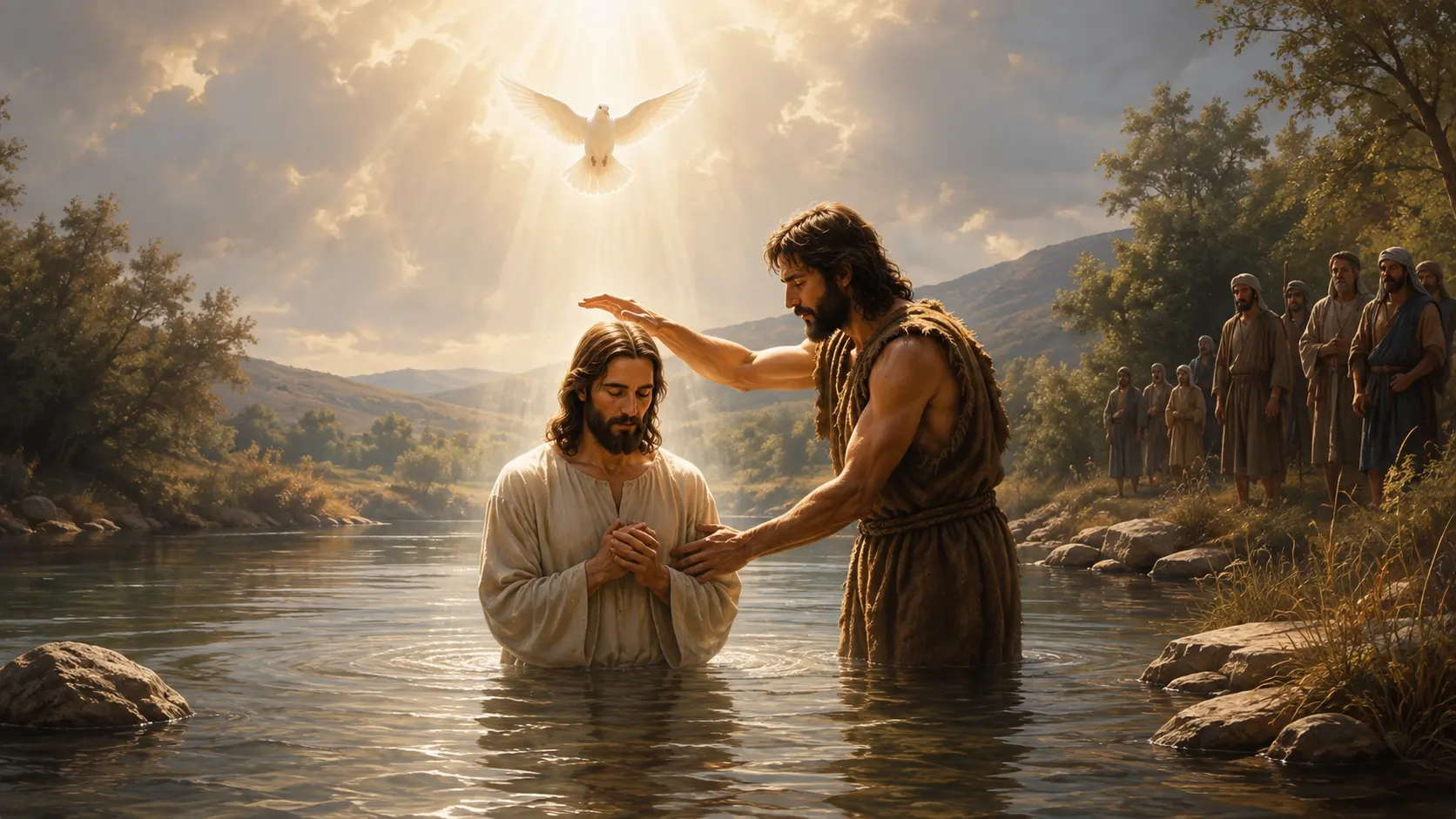
The Ministry of John the Baptist
Matthew 3
Overview
Matthew 3 introduces John the Baptist, the man God raised up to prepare the way for the coming Messiah.
John’s birth itself had been extraordinary. He was born to Zechariah and Elizabeth through God’s miraculous intervention, as recorded in Luke 1. His ministry would later take him into the wilderness of Judea, where his message was simple and urgent:
“Repent, for the kingdom of heaven is at hand.” — Matthew 3:2
Observations
The Call to Repentance (vv. 1–2)
John’s message was a call to repentance.
But what exactly is repentance?
Repentance is more than feeling guilty or feeling sorry for sin. It is an action word. It involves a change of mind that results in a change of direction. It is not merely sorrow in the heart; it is turning from one way of life toward another.
This raises an important question: Is repentance something we must do before we can come to God?
Yes and no.
Repentance does not describe some work we perform in order to make ourselves worthy of approaching God. Rather, it describes what coming to God looks like. We come to Him by turning away from our old direction and turning toward Him.
In this sense, repentance stands at the very beginning of the gospel message.
- It was the first word of John the Baptist’s preaching: “Repent” (Matthew 3:2).
- It was the first word of Jesus’ preaching: “Repent” (Matthew 4:17; Mark 1:14–15).
- It was part of the message preached by the twelve disciples (Mark 6:12).
- It was part of Jesus’ instruction to His disciples after His resurrection (Luke 24:46–47).
- It was the central appeal of the first Christian sermon at Pentecost (Acts 2:38).
- It was a repeated appeal in the preaching ministry of Paul (Acts 26:19–20).
Repentance, therefore, is not a minor theme of Christianity. It lies at the heart of the gospel invitation.
Yet John’s message was not simply, “You are sinners; therefore, repent.” His message carried something greater: The King is coming.
The call to repentance was a response to the announcement that God’s kingdom was drawing near. Something was happening in history. The Messiah was coming, and Israel needed to be ready to receive Him.
”Prepare the Way of the Lord” (vv. 3–4)
Matthew identifies John through the prophecy of Isaiah:
“The voice of one crying in the wilderness: Prepare the way of the Lord; make His paths straight.” — Isaiah 40:3
Matthew is drawing from Isaiah 40:3 to identify John as the promised forerunner of the Messiah.
The imagery of making the paths straight comes from the ancient practice surrounding the journeys of eastern monarchs. When a king travelled through a region, workers could be sent ahead to prepare the road for his arrival — to clear obstacles, level difficult ground, and remove anything that might hinder his passage.
John’s ministry fulfilled this image spiritually.
The road that needed preparation was not primarily a physical road. It was the human heart.
To prepare the way of the Lord meant removing the spiritual obstacles that prevented people from receiving the Messiah. Pride, hypocrisy, self-righteousness, attachment to sin, and spiritual indifference had to be confronted.
The real preparation for the coming of Christ must therefore take place within us.
John in the Spirit and Power of Elijah (vv. 4)
Matthew describes John as wearing clothing made of camel’s hair, with a leather belt around his waist.
This appearance recalls the prophet Elijah, who was similarly described in 2 Kings 1:8.
The similarity was not accidental.
Both Elijah and John had ministries marked by austerity, courage, and confrontation. Neither shaped his message to please the religious establishment. Both fearlessly called God’s people away from apostasy and back to Him.
Yet John was not attempting to imitate Elijah merely in appearance.
Before John’s birth, the angel had already declared concerning him:
“He will also go before Him in the spirit and power of Elijah…” — Luke 1:17
John’s Elijah-like ministry was therefore part of God’s purpose for his life.
His entire life reflected the seriousness of his calling.
Spurgeon captured something of this attitude in the prayer:
“Lord, let not my meat, my drink, or garment hinder me in Thy work.” — Spurgeon
John’s life was stripped of unnecessary distractions because his mission was clear: prepare people for Christ.
The Baptism of John (vv. 5–12)
Matthew tells us that people came to John and:
“were baptized by him in the Jordan, confessing their sins.” — Matthew 3:6
John offered baptism as an outward demonstration of repentance.
The word baptize carries the idea of immersing or overwhelming. But the significance of John’s baptism was greater than the physical act itself.
For a Jew in John’s day to submit to this baptism was a remarkable confession. It was essentially an acknowledgment: “I am not right with God merely because I belong to Israel. I am a sinner, and I need to be made right with Him.”
This struck at religious pride.
Before anyone can truly receive the kingdom of heaven, there must first be a recognition of our poverty of spirit (Matthew 5:3). We must recognize our need.
John’s baptism did not itself remove sin. It was a visible expression of repentance and of the person’s desire to turn toward God.
Christian baptism carries this idea of repentance but goes further. The believer is baptized into Christ, identifying with His death and resurrection:
“We were buried with Him through baptism into death…” — Romans 6:4
Christian baptism therefore points not only to repentance, but also to union with Christ and participation in the new life made possible through Him.
Confessing Their Sins
Matthew makes another important observation: the people were baptized “confessing their sins.”
Their confession gave meaning to the baptism.
Without repentance and acknowledgment of guilt, immersion in the Jordan would have amounted to little more than washing the body. The spiritual significance came from the inward reality represented by the outward act.
True repentance requires honesty about sin.
We cannot genuinely turn toward God while refusing to acknowledge what we are turning away from.
Jesus Comes to John for Baptism (vv. 13–15)
Then something remarkable happens.
Jesus Himself comes from Galilee to the Jordan and asks John to baptize Him.
John immediately recognizes that something appears wrong with this picture.
He says: “I need to be baptized by You, and are You coming to me?”
John’s baptism was a baptism connected with repentance. Yet Jesus had no sins of which He needed to repent.
Why, then, was Jesus baptized?
Jesus answered:
“Permit it to be so now, for thus it is fitting for us to fulfill all righteousness.” — Matthew 3:15
Jesus was not baptized because He had sinned.
His baptism formed part of His identification with the fallen human race He had come to save.
Throughout His earthly mission, Jesus willingly stepped into the place of sinners. His baptism was one important step in that identification — a mission that would reach its fullest expression at the cross.
He who had no sin entered the waters associated with repentance, standing among those He had come to redeem.
The Father, the Son, and the Holy Spirit (vv. 16–17)
As Jesus came up from the water, Matthew records an extraordinary scene.
The heavens were opened.
The Spirit of God descended upon Jesus like a dove.
And a voice from heaven declared:
“This is My beloved Son, in whom I am well pleased.” — Matthew 3:17
Here, at the beginning of Jesus’ public ministry, God openly identifies Jesus as His Son.
The Father declares His pleasure in the Son.
The Spirit descends upon Him.
And Jesus stands in the water, having willingly identified Himself with humanity.
The scene gives us a beautiful picture of the relationship and cooperation between the Persons of the Trinity: God the Father loves God the Son, and the Father communicates that love as God the Holy Spirit descends upon Him.
The Spirit Descending Like a Dove
The Spirit of God descended upon Jesus like a dove and remained upon Him.
This was not merely symbolic language without reality behind it. John the Baptist later testified that he had seen this event and understood its significance (John 1:32–34).
Jesus was about to begin His public ministry, and He would carry out that ministry in the power of the Holy Spirit.
The dove is also a fitting picture of the character of the Spirit’s work: gentleness, purity, peace, and love.
Immediately before Jesus enters the wilderness and then begins His public ministry, heaven bears witness to who He is and to the power in which His ministry will be carried out.
Cross-references
- Isaiah 40:3 — The prophecy of a voice crying in the wilderness, preparing the way of the Lord; fulfilled in John
- Luke 1:17 — The angel’s declaration that John would come “in the spirit and power of Elijah”
- 2 Kings 1:8 — Elijah described in clothing John’s attire consciously recalled
- Matthew 4:17 — Jesus opens His own ministry with the same call: “Repent, for the kingdom of heaven is at hand”
- Acts 2:38 — Repentance at the center of the first Christian sermon at Pentecost
- Romans 6:4 — Christian baptism as burial and resurrection with Christ — going beyond John’s baptism of repentance
- Matthew 5:3 — “Blessed are the poor in spirit” — the poverty of spirit that makes repentance possible
- John 1:32–34 — John the Baptist’s own testimony: he saw the Spirit descend and remain, confirming Jesus as the Son of God
Questions for reflection
-
Repentance is described here not as a work we perform to earn access to God, but as what coming to God looks like. How does this reframe the way you think about your own need to repent — past, present, and ongoing?
-
John’s whole life was stripped of unnecessary distractions because his mission was clear. What distractions — things not necessarily sinful in themselves — might be hindering your own calling and usefulness for God?
-
Jesus entered the waters of repentance-baptism not because He needed to, but because He chose to fully identify with the people He came to save. How does the picture of Jesus standing in the Jordan among sinners shape the way you see His identification with you in your own sin and need?
Comment received
Thank you — it will appear here once reviewed.